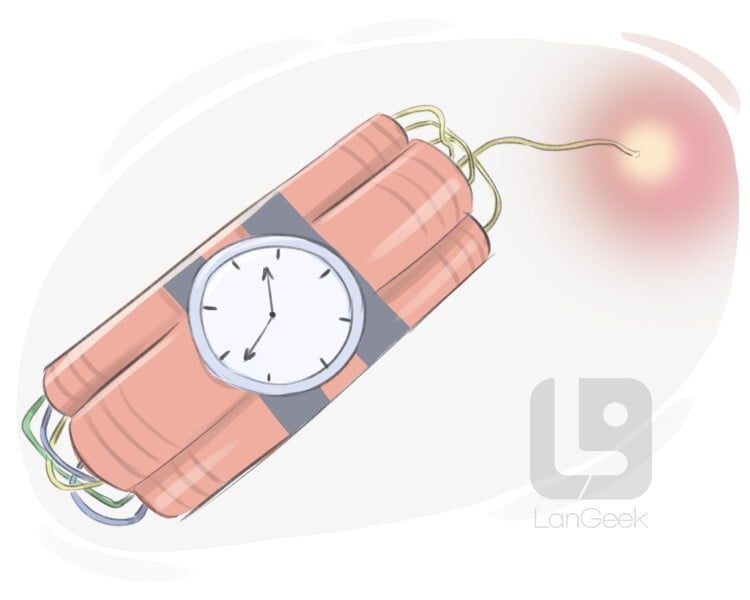
to go off
go
gəʊ
gew
off
ɒf
of

Définition et signification de « go off » en anglais

to go off
01

exploser

(of a gun, bomb, etc.) to be fired or to explode 
Intransitive
to go off definition and meaning
informations grammaticales
composition morphologique
à particule
verbe d’action
régulier
inséparable
particule
off
verbe de base
go
présent
go off
3e personne du singulier
goes off
participe présent
going off
passé simple
went off
participe passé
gone off
Exemples
The fireworks are scheduled to go off at midnight for the New Year's celebration. 

Les feux d'artifice sont prévus pour partir à minuit pour la célébration du Nouvel An.

02

partir précipitamment, s'enfuir

to run away or leave abruptly, especially to avoid an unpleasant situation or person 
Intransitive
Exemples
The deer sensed danger and went off into the woods to escape from the approaching hunters. 

Le cerf a senti le danger et est parti dans les bois pour échapper aux chasseurs qui approchaient.

03

se déclencher, s'activer

to be activated and start functioning 
Intransitive
Exemples
The car's airbag went off upon impact, protecting the driver. 

L'airbag de la voiture s'est déclenché lors de l'impact, protégeant le conducteur.

04

se dérouler, avoir lieu

to take place or occur in a particular way or manner 
Intransitive: to go off in a specific manner
Exemples
The party went off without a hitch, and everyone had a great time. 

La fête s'est déroulée sans accroc, et tout le monde a passé un bon moment.

05

s'éteindre, cesser de fonctionner

to stop working or functioning 
Intransitive
Exemples
The power went off during the storm, leaving us in the dark. 

Le courant s'est coupé pendant la tempête, nous laissant dans le noir.

06

ne plus (du tout) apprécier

to experience a loss of interest or liking towards someone or something 
Dialectbritish flagBritish
Transitive: to go off sb/sth
Exemples
Jenny went off her ex-boyfriend when she discovered he had been dishonest with her. 

Jenny a décroché de son ex-petit ami quand elle a découvert qu'il avait été malhonnête avec elle.

07

se gâter, tourner

(of food and drinks) to become spoiled or rotten and no longer be safe to consume 
Intransitive
Exemples
The milk went off because I left it out of the refrigerator for too long, and it started to smell sour. 

Le lait a tourné parce que je l'ai laissé hors du réfrigérateur trop longtemps, et il a commencé à sentir le rance.

08

sonner, se déclencher

(of alarms) to start making a lot of noise as a warning or signal 
Intransitive
Exemples
My alarm clock goes off at 6:00 AM sharp every morning. 

Mon réveil sonne à 6h00 pile tous les matins.

09

se détériorer, décliner

to decline in condition or quality 
Intransitive
Exemples
The once beautiful garden has gone off due to neglect, with overgrown weeds and dying plants. 

Le jardin autrefois magnifique a décliné en raison de la négligence, avec des mauvaises herbes envahissantes et des plantes mourantes.

10

partir, s'en aller

to depart from a place, usually for a specific purpose or activity 
Intransitive: to go off | to go off somewhere
Exemples
He went off to buy some groceries. 

Il est parti acheter des courses.

11

s'endormir, tomber dans le sommeil

to enter a state of sleep 
Intransitive
Exemples
The baby finally went off after a lullaby and some rocking in the crib. 

Le bébé a finalement dormi après une berceuse et quelques balancements dans le berceau.

12

s'emporter, exploser

to express one's anger or irritation toward the person who caused it 
Intransitive: to go off on sb
Exemples
When I mentioned his mistake, he went off on me, shouting and pointing fingers. 

Quand j'ai mentionné son erreur, il est parti en vrille sur moi, criant et pointant du doigt.

LanGeek

Télécharger l'Application
langeek application

Download Mobile App

App Store