
radical
ra
ˈræ
di
di
cal
kəl
kēl
British pronunciation
/ˈrædɪkəl/

Definition & Meaning of "radical"in English

radical
01

supporting total and extreme social or political changes
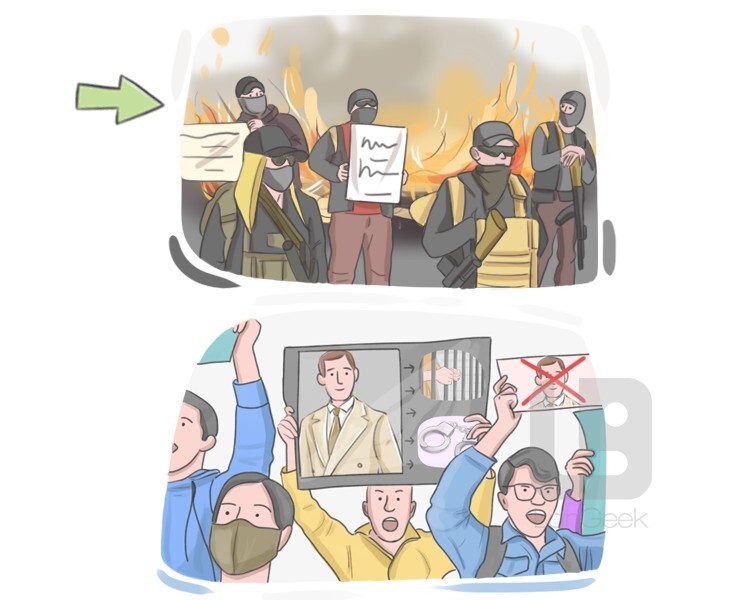
radical definition and meaning
example
Examples
The radical activist advocated for the overthrow of the government to establish a new social order.
02

(of actions, ideas, etc.) very new and different from the norm

example
Examples
The scientist proposed a radical theory that challenged established beliefs.
03

originating from or relating to the root or source of something

example
Examples
The scientist studied the radical causes of the disease.
04

(of leaves) growing at or arising from the base of a plant or directly from the root or rootstock

example
Examples
The plant has several radical leaves sprouting at its base.
05

of or relating to a root in language, such as the root of a word

example
Examples
The radical of the verb conveys its essential meaning.
Radical
01

a group of atoms bonded together that behaves as a single unit within a molecule

example
Examples
The hydroxyl radical is highly reactive and plays a key role in many chemical reactions.
02

an atom or group of atoms with at least one unpaired electron, often highly reactive

example
Examples
Free radicals can damage cells if not neutralized.
03

a person who holds extreme or unconventional ideas or opinions

example
Examples
The radical spoke passionately at the town hall.
04

a character or component conveying the lexical meaning of a logogram

example
Examples
The radical in the character indicates its semantic category.
05

the form of a word after all affixes are removed

example
Examples
The radical of " unhappiness " is " happy. "
06

a quantity expressed as the root of another quantity

example
Examples
The radical √16 equals 4.
LanGeek
Download LanGeek app
langeek application

Download Mobile App

stars

app store